|
|
The annual NewSpace Conference by the Space Frontier Foundation will get underway later today in San Jose, California. A highlight of today’s events is the “Lightning Pitch Competition” for NewSpace startups. This takes the place of full-fledged business plan competition that has taken place at some previous conferences. Instead of submitting a detailed business plan and having that plan, and presentation of it, reviewed by judges, each company will give a four-minute pitch about their company to judges during a conference session late Thursday morning. At stake are $30,000 in prizes, including a $20,000 grand prize.
Last month, the competition organizers announced the eight companies that will be participating in this year’s event. More than have are making use of CubeSats or other smallsats, or supporting such spacecraft, in one manner or another. A quick review of the eight contestants follows.
Accion Systems: This company, founded by MIT students and faculty, is seeking to commercialize an electric propulsion system they have developed for CubeSat-class spacecraft. This ion electrospray technology is already being planned for use on some CubeSats, including the proposed student-led Time Capsule to Mars mission. Notable: the company’s team includes MIT professor Paulo Lozano, who is listed as “Intergalactic Space Captain.”
Cubecab: Cubecab, based in Mountain View, California, says it plans to develop dedicated launch services for CubeSats. The company hasn’t released any details about its technical approach, though. The company’s website also doesn’t disclose any information about the company’s team, although the domain name is registered to an Adrian Tymes.
Cuberstation: Palo Alto, California-based Cuberstation plans to provide “dedicated ground services to nano/micro satellite operators” with its own global network. The company says it will operate a network of six ground stations located at high latitudes to provide regular communications with smallsats. (The high latitudes suggests they’re interested in satellites in sun-synchronous and similar polar orbits.) The company describes itself as “a group of young and dynamic individuals coming from a multi-national background of 6 countries” without disclosing their names on the company’s Facebook page (it doesn’t have its own website yet.)
Elysium Space: No, they’re not planning to build a giant space colony so the wealthy can flee Earth; wrong “Elysium.” This San Francisco company plans to get into the “space burial” business by launching samples of cremated remains into orbit within a CubeSat-sized spacecraft. That’s similar to what Celestis has done in the past (with limited success, given the paucity of missions they’ve flown) although Elysium Space plans a modern twist, giving customers a mobile app so they can track their loved one’s location in space. Their first launch is planned for October, apparently as a secondary payload on an Orbital Antares launch of a Cygnus cargo spacecraft to the ISS.
Hive: Phoenix-based Hive “delivers small satellites to orbit, en masse, through a patent-pending dispensing module.” That’s it. The release gives no other information about the company, including any website or social media contacts.
RockZip: This company, based in Michigan City, Indiana, develops “highballoons,” or high-altitude balloons. They believe their approach will cost “significantly” under current costs of $1,000-1,500 per balloon, they note on their website, targeting researchers, business, and even the general public.
Space Resources Extraction Technology: The Huntsville company plans to “Microwave the moon to extract water from the polar permafrost to produce rocket propellant for exploration of the space frontier.” Another company without a website, the release instead directs people to do a Google search for “microwave the moon for water,” which turns up, among other entries, a NASA Marshall Space Flight Center press release from 2009 about such an approach being studied by NASA scientist Edwin Ethridge.
Terran Science Group: TSG describes itself as “a collection of expert technical and engineering professionals based in Central Florida that provide high-value solutions to companies working on the cutting edge of their respective fields.” According to the competition announcement, they’re interested in projects “like safe havens on the Earth, moon, or Mars built from local regolith and a big laser!” Their website suggests their interests are even more diverse, although the specific near-term business opportunities appear less certain.
The winners of the competition will be announced at a reception at the end of the day today.
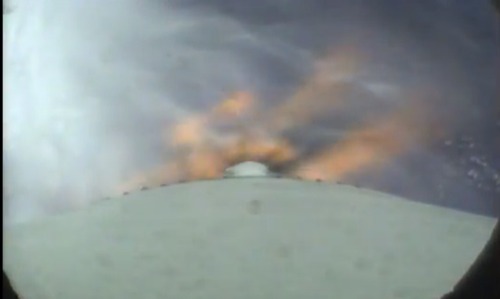 A still from a SpaceX video reeled July 22 shows the Falcon 9 first stage performing a reentry burn after its July 14 launch. (credit: SpaceX) SpaceX provided an update Tuesday on last week’s test of a Falcon 9 v1.1 first stage landing during the launch of six ORBCOMM satellites. The company released a video that showed the first stage, after separating from the upper stage, firing its engines for a reentry burn to slow down. Later, the engines fire again and the stage’s landing legs deploy as it approaches the ocean surface. SpaceX said the rocket did a soft “landing” on the ocean surface and remained upright for a few seconds before toppling over to the horizontal position. That fall caused a “loss of hull integrity” in the stage, but did not prevent SpaceX from collecting the information it needed for that test.
One glitch with the test was ice that formed on the camera filming the stage’s descent. The company said it is “taking steps to minimize the build up of ice and spots on the camera housing” for future flights.
SpaceX will stand down from these landing tests for the next two Falcon 9 v1.1 flights. “However, our next couple launches are for very high velocity geostationary satellite missions, which don’t allow enough residual propellant for landing,” the company explained. Those launches are of the AsiaSat 8 and AsiaSat 6 satelites, with the first tentatively scheduled for early August. SpaceX also did not attempt landing tests on launches of two other GEO satellites in December 2013 and January 2014.
“We will attempt our next water landing on flight 13 of Falcon 9, but with a low probability of success,” the company said. That would be the fourth Commercial Resupply Services (CRS) mission for NASA, planned for no earlier than September 12. The company didn’t explain why that mission had a “low probability” of success given that the most recent test appeared to go well.
The following two launches would attempt to land the stage on a “solid surface,” although it’s not clear if that would be back at Cape Canaveral or on a barge or other platform in the ocean. SpaceX said it has been in discussions with the Air Force to identify locations at Cape Canaveral Air Force Station to support Falcon 9 landings. Those two tests, the company added, have “an improved probability of success.” Those launches, according to the current manifest, are of the second group of ORBCOMM Generation 2 satellites and the fifth CRS mission.
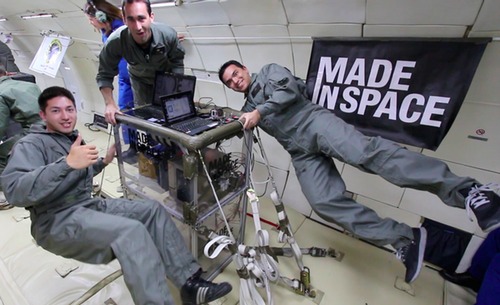 Made In Space employees test a 3-D printer on a parabolic aircraft flight in 2013, prior to its launch to the ISS later this year. A new report concludes that the near-term benefits of 3-D printing in space have been exaggerated. (credit: Made In Space) As NASA prepares to launch the first 3-D printer for the International Space Station (ISS), a report released today says that while the technology may have considerable long-term benefits, its short-term potential has been exaggerated.
The National Research Council report, “3D Printing in Space,” examined the current state of 3-D printing, also known as additive manufacturing, and its potential applications in space. The report, sponsored by NASA and the US Air Force, concluded that the technology has benefits, but not necessarily in the immediate future.
“Many of the claims made in the popular press about this technology have been exaggerated,” said Robert Latiff, chair of the committee that prepared the report, in a statement accompanying the report. “For in-space use, the technology may provide new capabilities, but it will serve as one more tool in the toolbox, not a magic solution to tough space operations and manufacturing problems.”
The report echoes Latiff’s comments. “The specific benefits and potential scope of additive manufacturing remain undetermined, and there has been a substantial degree of exaggeration, even hype, about its capabilities in the short term,” the report states. “The realities of what can be accomplished today, using this technology on the ground, demonstrate the substantial gaps between the vision for additive manufacturing in space and the limitations of the technology and the progress that has to be made to develop it for space use.”
The concept of using 3-D printing in space has been attractive to some within NASA and industry for some time. A 3-D printer on the ISS or future spacecraft could, for example, simplify the logistical challenges of stocking spare parts by allowing crews to print replacement parts as needed from a common “feedstock” of material, like plastic or metal. Others have argued that 3-D printing could be used to manufacture structures or even entire spacecraft not possible on the ground.
The report notes that long-term potential for 3-D printing, and recommends that future uses of the technology be evaluated not just on its ability to lower costs but also to enable new capabilities. There are many challenges, though, associated with those capabilities, including difficulties getting 3-D printing to work in the microgravity and vacuum environments of space. Additive manufacturing also has significant power requirements, the report notes, and requires a stable platform free of significant vibrations, both challenges in space.
The report does make a number of recommendations for NASA and the Air Force to support 3-D printing applications. For NASA, those recommendations include identifying research projects for the short and medium term, particularly on the ISS. It also recommends NASA create “an agency-wide space-based additive manufacturing working group” to develop a technology development roadmap for 3-D printing that stretches out as far into the future as 2050. The Air Force, whose interest in 3-D printing in space is not as well established as NASA’s, should take similar steps to identify uses of the technology and experiments that can be flown in space to demonstrate it.
The release of the report comes as NASA prepared to launch the first 3-D printer designed for use on the ISS. That printer, developed by Silicon Valley startup Made In Space, is slated to fly on the next SpaceX commercial cargo flight to the ISS, currently scheduled for launch no earlier than September 12.
Jason Dunn, co-founder and chief technologist of Made In Space, said at the Future Space 2014 conference Thursday in Washington that the printer is completed and in NASA’s hands for eventual loading on the SpaceX Dragon spacecraft that will fly to the ISS. That printer is the first step in the company’s long-term goal in eventually being able to manufacture nearly anything in space, getting around the “bottleneck” of space access.
“This printer will be the first thing to ever manufacture anything off Earth,” he said. “It represents the beginning of a long path towards expanding our presence in space.”
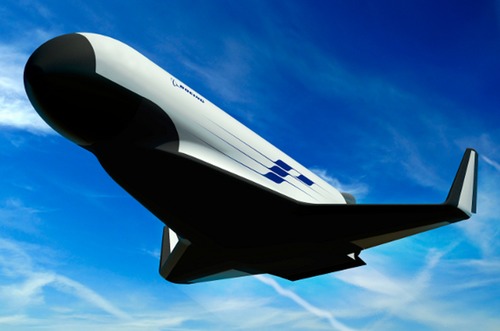 Boeing’s concept for the XS-1 spaceplane, one of three selected by DARPA for Phase 1 studies. (credit: Boeing) The Defense Advanced Research Projects Agency (DARPA) announced Tuesday it has awarded study contracts to three teams, representing a mix of established and entrepreneurial space companies, to study concepts for a reusable suborbital spaceplane.
DARPA said it awarded contracts to three teams: Boeing, working with Blue Origin; Masten Space Systems, working with XCOR Aerospace; and Northrop Grumman, working with Virgin Galactic. The contracts, for phase one of the Experimental Spaceplane 1 (XS-1) program, cover initial design work on concepts for the vehicle, designed to serve as a reusable lower stage of a low-cost launch system for medium-sized satellites.
“We chose performers who could prudently integrate existing and up-and-coming technologies and operations, while making XS-1 as reliable, easy-to-use and cost-effective as possible,” said DARPA XS-1 program manager Jess Sponable in a DARPA statement announcing the contracts. “We’re eager to see how their initial designs envision making spaceflight commonplace—with all the potential military, civilian and commercial benefits that capability would provide.”
The DARPA statement did not reveal the size of the contracts. However, DARPA has earlier announced, though a Federal Business Opportunities posting, a contract award to Masten valued at just under $3 million. Boeing, in its own press release about the contract, said its contract was valued at $4 million, although it wasn’t clear if that included any award to Blue Origin.
Boeing also released an illustration of its XS-1 concept, a winged vehicle. “Boeing brings a combination of proven experience in developing launch systems and reusable space vehicles, along with unparalleled expertise in the development and fielding of highly operable and cost-effective transportation systems,” said Steve Johnston, director of Boeing’s Phantom Works Advanced Space Exploration division, in the Boeing release.
The goal of the XS-1 program is to develop a vehicle capable of flying ten times in ten days, including at one least one flight to Mach 10. The XS-1, coupled with an expendable upper stage, would be able to launch satellites weighing up to about 2,270 kilograms into low Earth orbit for no more than $5 million a flight. The vehicle could also serve as hypersonics technology testbed. DARPA will select a company in a Phase 2 some time next year to build the XS-1.
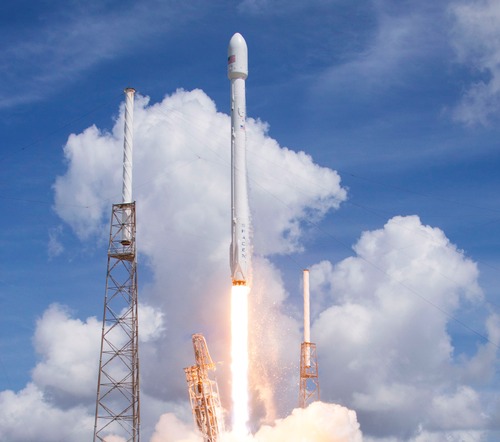 A Falcon 9 v1.1 lifts off from Cape Canaveral, Florida, on July 14, carrying six ORBCOMM satellites. (credit: SpaceX) It took two months, and a fair amount of drama, but SpaceX finally successfully launched six ORBCOMM Generation 2 (OG2) satellites on Monday. The Falcon 9 v1.1 rocket lifted off from Cape Canaveral at 11:15 am EDT (1515 GMT) and started deploying its payload six OG2 satellites about 15 minutes later. All six satellites, built by Sierra Nevada Corporation, are in their planned low Earth orbits and in good condition, ORBCOMM confirmed in a press release Monday afternoon. ORBCOMM said a second batch of 11 OG2 satellites should launch by the end of the year, also on a Falcon 9.
The launch was originally planned for May 10, but was postponed when an issue cropped up during an attempted static test firing. The launch slipped until mid-June, when an issue with one of the six OG2 satellites had an issue that pushed back the launch a week. A technical issue scrubbed a June 20 launch, then weather postponed a June 21 attempt, and another technical issue, coupled with range maintenance, pushed back a June 22 launch until Monday. In the middle of all that, SpaceX kicked up a firestorm of criticism when it announced it would not webcast a June 21 launch.
SpaceX did webcast the Monday launch, although it was a more low key affair, starting less than 15 minutes before launch, with primarily audio from launch control with a little commentary. The webcast ended prior to payload separation, although that was consistent with some prior SpaceX webcasts.
The webcast also did not cover the attempt to recover the Falcon 9 first stage, which the company planned to make a soft “landing” in the ocean as a test of efforts to eventually reuse the first stage. SpaceX CEO Elon Musk later reported on Twitter mixed success with the test: the stage did appear to touch down on the ocean surface, but it broke apart immediately thereafter:
SpaceX has not announced when the next Falcon 9 launch will take place. According to the manifest on its website, it has two missions coming up for communications satellite operator AsiaSat, who announced in June that the AsiaSat 8 satellite had arrived at the Cape for a planned August launch. On Sunday, NASA said it had tentatively scheduled SpaceX’s next Dragon cargo mission to the International Space Station, SpaceX-4, for launch no earlier than September 12.
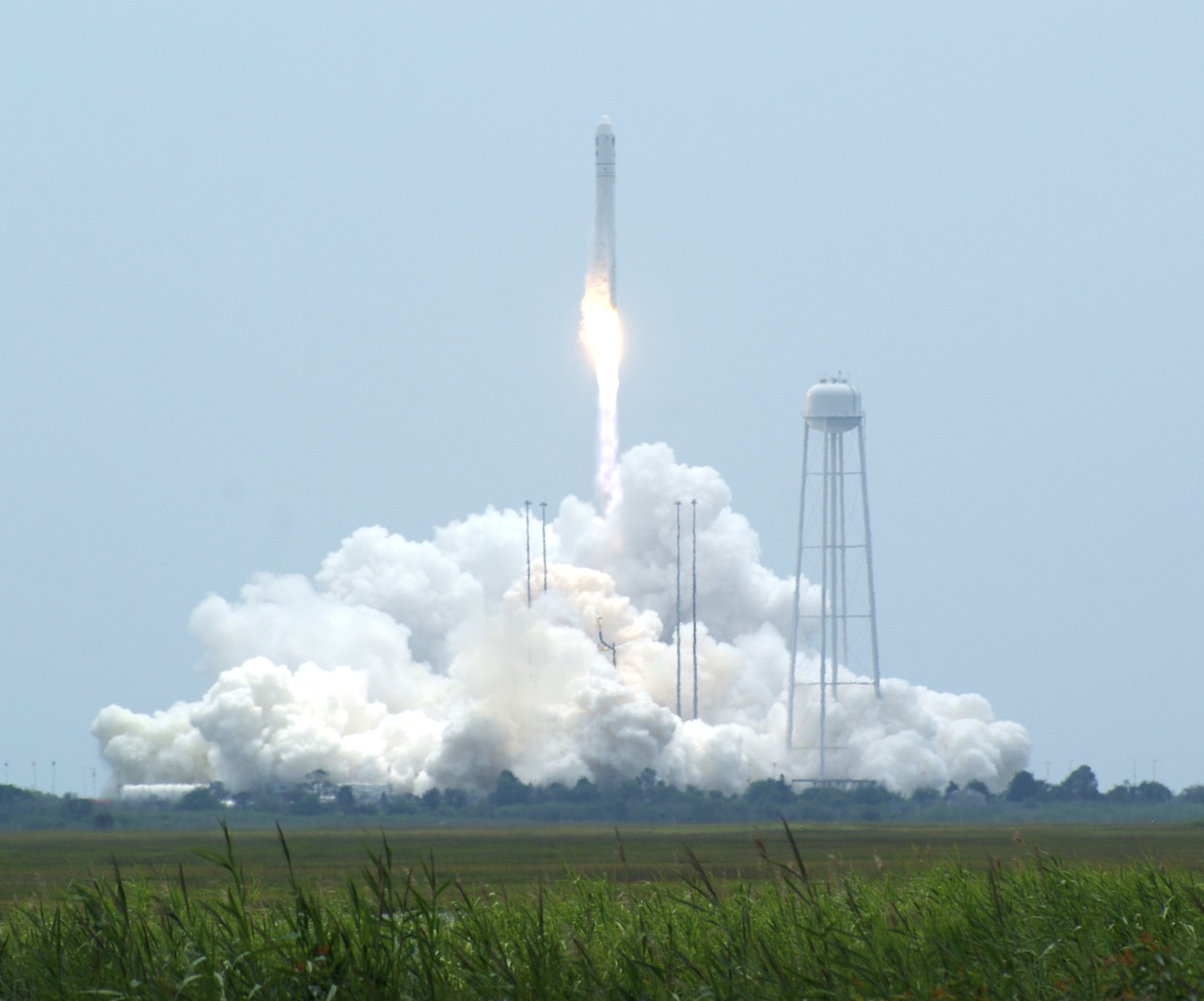
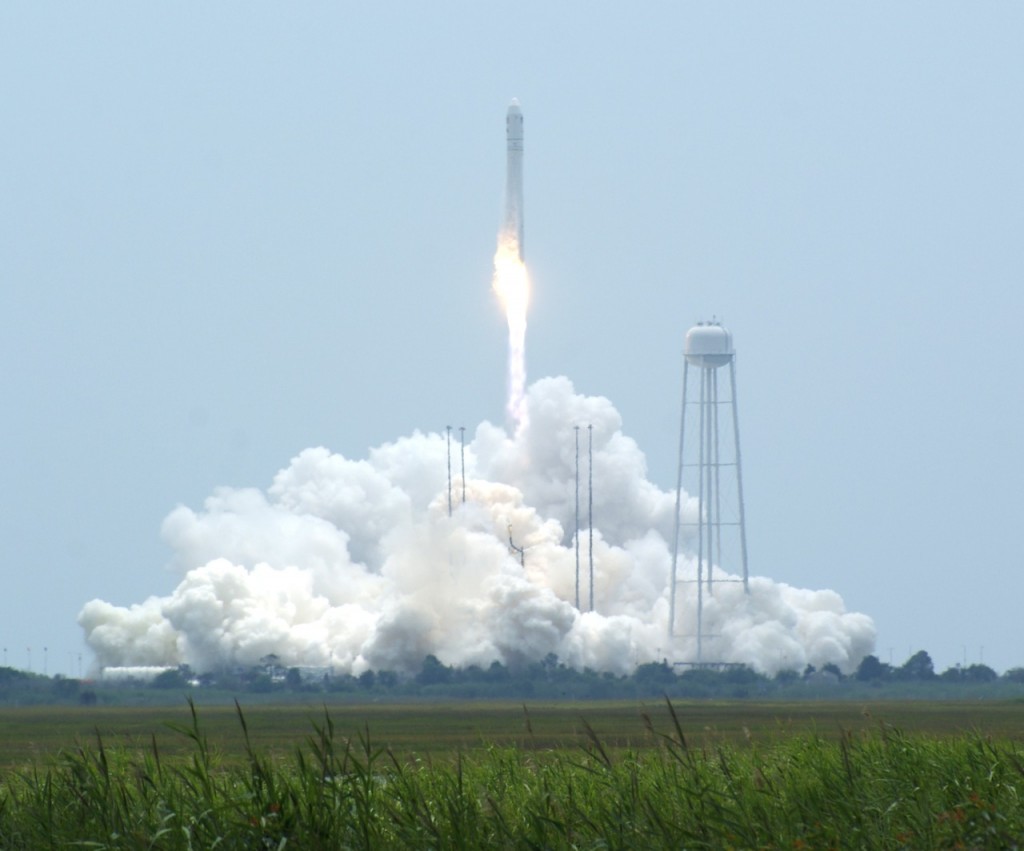 An Antares rocket lifts off from the Mid-Atlantic Regional Spaceport (MARS) at Wallops Island, Virginia, on July 13, 2014. The Antares placed a Cygnus cargo spacecraft into orbit on the second of eight cargo missions to the ISS. (credit: J. Foust) Technology and meteorology finally cooperated on Sunday as an Orbital Sciences Corporation Antares rocket successfully launched a Cygnus cargo spacecraft on a mission to the International Space Station.
The Antares rocket lifted off from the Mid-Atlantic Regional Spaceport at Wallops Island, Virginia, at 12:52 pm EDT (1652 GMT) after a smooth countdown. Although the rocket disappeared into the clouds around a minute after launch as seen from viewing sites near the pad, the rocket continued its ascent to orbit without incident, placing Cygnus into low Earth orbit about ten minutes after liftoff.
The Cygnus, named by Orbital “SS Janice Voss” after the late astronaut, contains a payload of 1,664 kilograms of cargo to the station (NASA lists a total mass of 1,493.8 kilograms; it does not count cargo packaging, which Orbital does.) It is scheduled to be grappled by the station’s robotic arm Wednesday at 6:39 am EDT (1039 GMT).
“Things went really well,” said Bill Gerstenmaier, NASA associate administrator for human exploration and operations, during a post-launch press conference Sunday afternoon. “It’s great to see this team come together.”
Orbital executive vice president Frank Culbertson said they worked some minor issues during the countdown, but otherwise it everything went smoothly. The Cygnus spacecraft is in orbit and functioning well, having already performed one post-launch burn. “All the systems on the spacecraft are operating nominally,” he said. “We’ve very excited about the fact that we’re in orbit and heading to the station.”
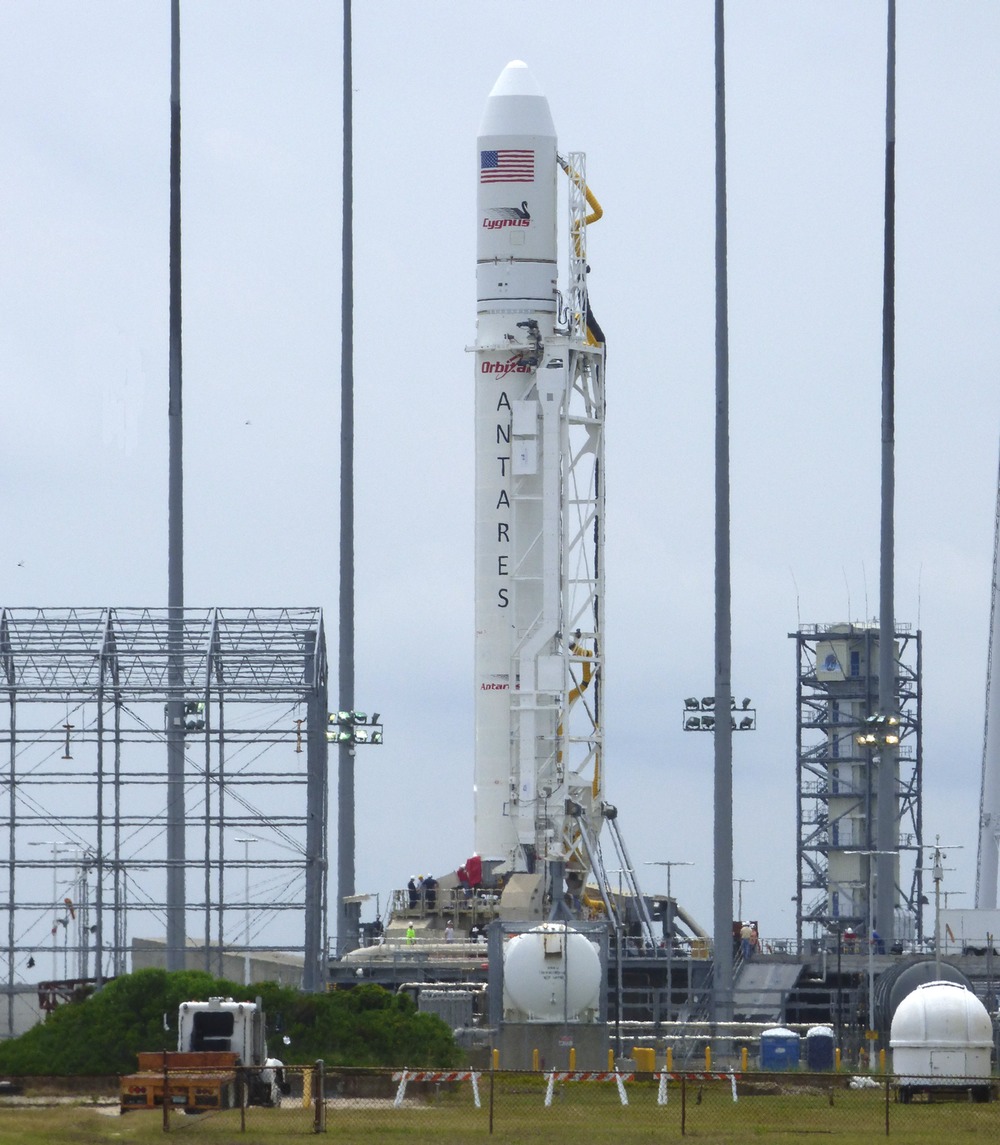
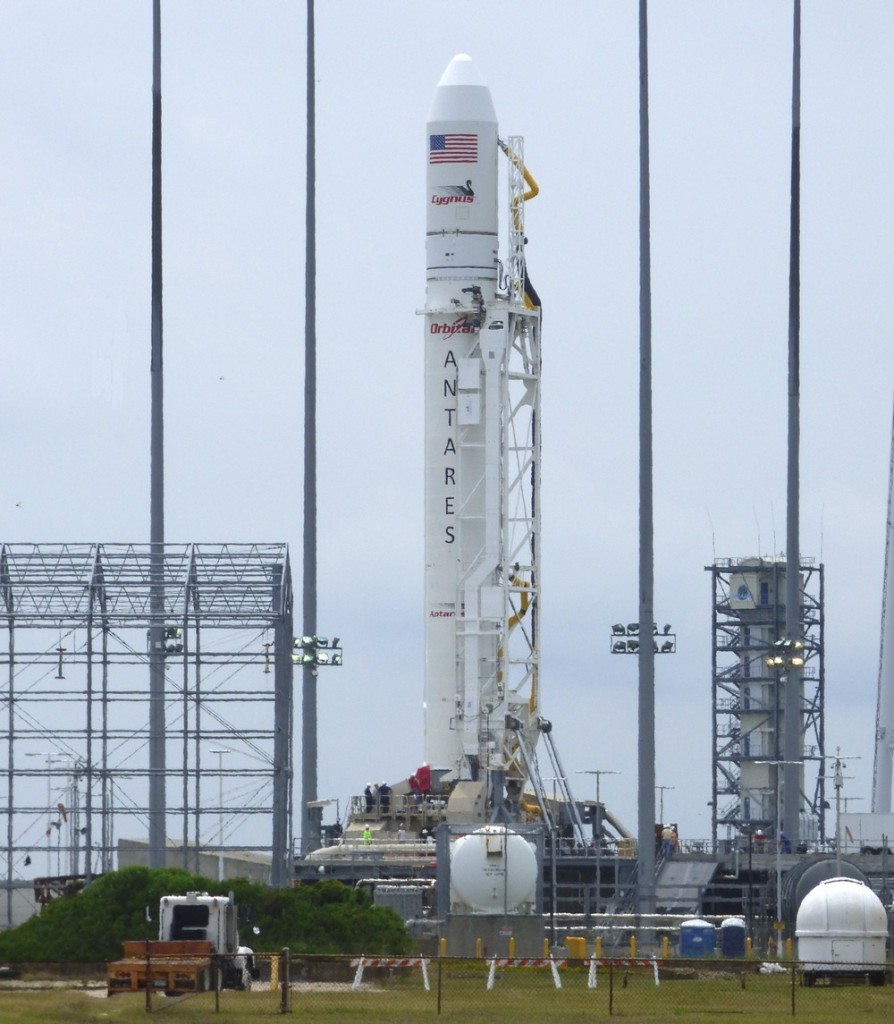 The Antares rocket for the Orb-2 mission to the ISS stands on the launch pad at the Mid-Atlantic Regional Spaceport (MARS) in Virginia on Friday, July 11. Launch is scheduled for July 13. (credit: J. Foust) NASA and Orbital Sciences said Saturday they believe that weather and technical issues are behind them and will be ready to launch a Cygnus cargo spacecraft to the International Space Station on Sunday.
Mission managers gave approval Saturday afternoon for the launch at 12:52 pm EDT (1652 GMT) Sunday of an Antares rocket on the Orb-2 commercial cargo mission to the station. That launch has been pushed back for two days after weather delayed launch preparations this week at the Mid-Atlantic Regional Spaceport (MARS) at Wallops Island, Virginia.
“It’s been a little bit of a challenge to get to this point, L-1,” said Frank Culbertson, executive vice president of Orbital Sciences, in a briefing Saturday afternoon at Wallops, referring to the milestone of one day before launch. The launch was originally planned for May but was pushed back first because of ISS schedules (including the delayed launch of a SpaceX Dragon cargo mission) and, more recently, because of concerns about the first stage engines on Antares.
Orbital officials have not gone into great detail about the concerns with the AJ26 engines that power the first stage. A failure of an AJ26 on a test stand at NASA’s Stennis Space Center in May—an engine being tested for a future Antares mission—prompted the delay of what had been planned to be an early June launch. In early July, Orbital announced that inspections of the two AJ26 engines on this Antares had been completed, and cleared the vehicle for launch.
“I can’t get into too much detail about the actual nature of the problem,” said Mike Pinkston, Antares program manager at Orbital. “Based on our investigation, we did do some specific, targeted investigations of the fleet of engines we have, notably the two that are on the Orb-2 rocket right now, and did see what we needed to see in terms of proper configuration of some specific features of concern. Obviously, those engines have a solid test history behind them as well, so we’re very confident we’ve got two good engines on the vehicle.”
With those technical issues behind them, weather is not expected to be a factor tomorrow. Sarah Daugherty, test director at NASA Wallops Flight Facility, said forecasts call for a 90% chance of acceptable weather for Sunday’s launch. There’s a very small chance of clouds, she said, hence the less-than-100% odds of acceptable weather. “They never give us 100%,” Culbertson quipped.
One other issue raised at Saturday’s briefing deals with the range. With the launch taking place midday Sunday in the middle of summer—the height of tourist season on the Virginia coast—there’s a concern recreational boaters could enter the hazard zone for the launch, potentially scrubbing it since the launch window lasts only five minutes.
“For this one, we have taken an extra step” because of the higher number of boaters expected on the waters, Daugherty said. That includes making visits to harbors in the area to remind boaters of the launch and the keep-out zones they need to observe. “We have made those extra strides for this launch, and we’re confident that we can have a clear range at the first second of that five-minute window.”
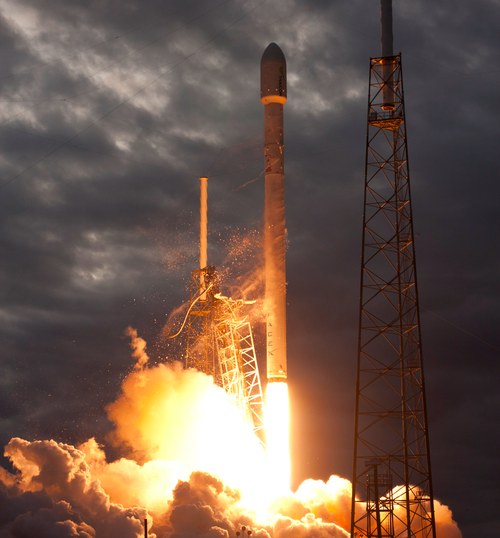 A Falcon 9 v1.1 lifts off from Cape Canaveral on January 6, 2014, carrying the Thaicom 6 satellite. This was the third of three launches certified as successful by the Air Force. (credit: SpaceX) As SpaceX battles with the Air Force on one front, suing the service to contest a “block buy” launch contract awarded to United Launch Alliance, it is also working with the Air Force to get the Falcon 9 rocket certified to perform launches of military satellites under the Evolved Expendable Launch Vehicle (EELV) program. On Friday, SpaceX announced a major milestone in that certification process: the Air Force has certified the first three Falcon 9 v1.1 launches, performed from late September 2013 through early January 2014, as successful.
As part of the overall certification process, a company must perform three successful launches of its vehicle, and have the success of those launches certified by the Air Force. The Air Force has signed off on the first Falcon 9 launch as a success previously (despite an issue restarting the rocket’s second stage after it deployed its payloads); Friday’s announcement covers the launches of commercial communications satellites in December and January. “Meeting the criteria for successful flights is a key milestone in the certification process,” SpaceX noted in its brief statement.
It is not the only milestone, though, as the Air Force has to thoroughly review the performance and reliability of the Falcon 9 v1.1, an ongoing process. SpaceX officials have previously said they hope to have the process completed by the end of the year, although Air Force officials have suggested it may not be done until early 2015.
This process has continued even as SpaceX sued the Air Force in April, contesting a block buy contract for EELV launches the Air Force awarded to ULA last year. That has caused some friction in the SpaceX-Air Force relationship, although Elon Musk has noted that his company is on good relations with most people in the Air Force, with the exception of those responsible for the block buy award.
The Air Force, meanwhile, has insisted it is serious about promoting competition for launch services and certifying companies like SpaceX. “When you’re spending $60 million and putting 100 people against the problem to get somebody certified, it’s hard to say you’re excluding them,” said Gen. William Shelton, head of Air Force Space Command, in a briefing with reporters during the 30th Space Symposium in Colorado Springs in May.
Shelton noted the three launches—which, at the time of the briefing, only one had been approved as successful by the Air Force—are just “openers” in the certification process. “There’s a tremendous amount of analysis that needs to be completed, and it’s in cooperation with SpaceX,” he said. That includes analysis of manufacturing and engineering processes, and an “auditable” financial system. “It’s very difficult to pick up the pace on that. It just takes time, it takes money, it takes people. And I think SpaceX would have a hard time going faster than they are right now.”
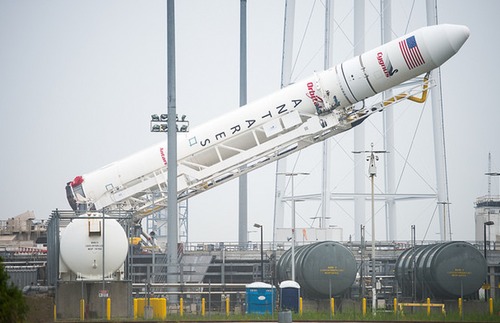 An Antares rocket is erected on the launch pad at the Mid-Atlantic Regional Spaceport in Virginia on Thursday. Weather has postponed the launch from Saturday to Sunday. (credit: NASA) Stormy weather this week on the Mid-Atlantic coast has struck again. Orbital announced Friday morning that it has delayed the launch of its Antares rocket carrying a Cygnus cargo spacecraft another day, from Saturday to Sunday. Storms Thursday evening interfered with launch preparations, resulting in the delay. On Wednesday, Orbital slipped the launch from Friday to Saturday, again after storms disrupted launch preparations.
Launch is now scheduled for Sunday at 12:52 pm EDT (1652 GMT). The one-day delay will also push back Cygnus’s arrival at the station a day, to 6:37 am EDT (1037 GMT) July 16. The good news is that the unsettled weather is coming to an end (although it is fairly cloudy at Wallops around midday Friday), and should not be an issue for this weekend’s launch attempts. Fingers crossed.
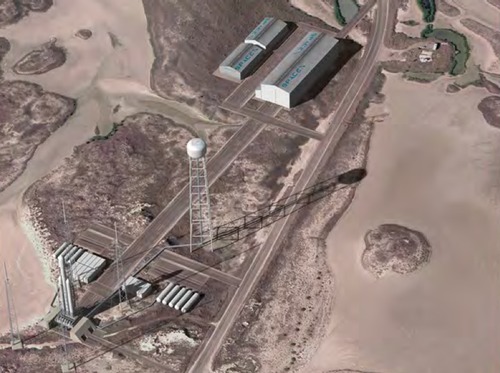 Illustration of SpaceX’s proposed launch site near Brownsville, Texas. The FAA gave its environmental approval to the site on July 9. (credit: SpaceX) The FAA has given its environmental approval for a proposed Texas launch site for SpaceX, one of the last milestones before the company makes a decision on a new commercial launch facility.
The FAA’s Office of Commercial Space Transportation (FAA/AST) issued Wednesday its “Record of Decision” on the proposed launch site on the coast of the Gulf of Mexico, east of Brownsville and just north of the Mexican border. The decision came at the end of a long environmental impact assessment of the proposed facility, which SpaceX would use for commercial launches of its Falcon 9 and Falcon Heavy launch vehicles. The FAA had released the final environmental impact statement (EIS) report in late May.
The FAA concluded that the environmental assessment supported what the report called the “selected action,” namely, the construction of the spaceport. “I find that the Selected Action described in this Record of Decision is reasonably supported,” concluded George Nield, FAA associate administrator for commercial space transportation, in a statement he signed at the end of the memo.
The memo does lay out a number of steps SpaceX will have to take in order to minimize the environmental impact of the proposed facility, which would support up to a dozen launches per year, up to two of which would be of the Falcon Heavy. These include a number of “reasonable and prudent measures” to protect local wildlife, steps to prevent pollution of the site by hazardous materials, protection of several historical sites in the area, and noise mitigation measures. For example, in the case of noise mitigation, “SpaceX will make hearing protection devices available to residents to reduce noise levels below 115 dBA at distances up to approximately 2.1 miles for the Falcon Heavy.”
The decision has bene widely seen as the final milestone before SpaceX formally announces its plans to develop the launch site in Brownsville. A SpaceX spokesperson told the Rio Grande Valley Morning Star newspaper that no decision has been made yet, though. “There remain several criteria that will need to be met before SpaceX makes a decision,” Hannah Post told the newspaper. “We are hopeful that these will be complete in the near future.”
While Post said that the Brownsville site was “a finalist” for that commercial launch site, company officials have made in clear in recent statements that it was their preferred site. At the May 29 rollout of the company’s Dragon V2 crew vehicle, SpaceX CEO Elon Musk mentioned the environmental impact statement final report that had just been released. “We’re pretty excited about building that out,” he said of the Brownsville site.
In fact, in the Record of Decision, SpaceX all but indicated they were interested in only the Brownsville site. “SpaceX considered sites in Puerto Rico, Florida, and Texas (City of McGregor, Kenedy County, Willacy County, and other properties in Cameron County),” the Record of Decision memo states. “None of the alternative sites sufficiently met SpaceX’s criteria; therefore, they were not evaluated in detail in the EIS.”
Earlier this week, a leading Florida official all but conceded that SpaceX would not choose a proposed commercial launch site near the Kennedy Space Center. Frank DiBello, the CEO of Space Florida, said Tuesday he expected SpaceX to announce it had decided on Brownsville site in the next week or two. “I am mad as hell, however, that we could not offer him a comparable alternative business site and environment here in time,” he said in a luncheon speech, as reported by Florida Today.
|
|

Recent Comments