|
|
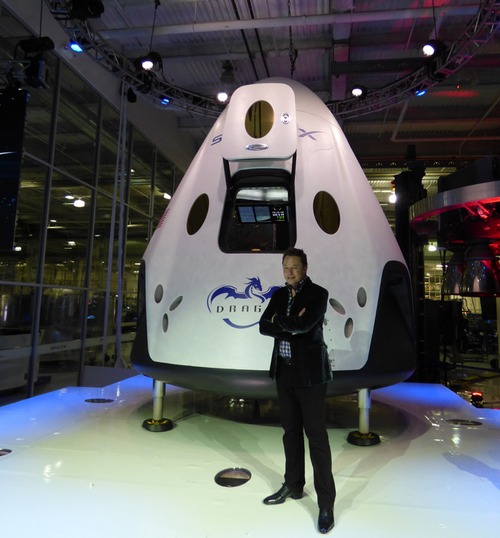 Elon Musk stands in front of the Dragon V2 spacecraft unveiled at SpaceX on May 29. SpaceX is one of three leading contenders for the next phase of NASA’s Commercial Crew program. (credit: J. Foust) The long-awaited decision on which company or companies will win contracts from NASA for the next phase of the agency’s commercial crew program can be expected by the end of this month, according to one report last night.
Charles Lurio, the well-connected publisher of The Lurio Report newsletter about the commercial space industry, tweeted Thursday night that he expected NASA to announce the awardees of the Commercial Crew Transportation Capability (CCtCap) contracts either next Friday, August 22, or the following Friday, August 29:
The suggested dates raised some eyebrows: why announce on a Friday (particularly the latter date, which would be the Friday before the three-day Labor Day weekend?) However, such a decision would not be unprecedented: when NASA announced the Commercial Crew Integrated Capability (CCiCap) awards in August 2012, they also did so on a Friday—the Friday before NASA’s Curiosity Mars rover landed on the Red Planet!
Three companies—Boeing, Sierra Nevada Corp., and SpaceX—are the leading contenders for the CCtCap contracts. Lurio also said he expected NASA to make two “full” awards, rather than one full-sized award and a “half-sized” award that would be enough to allow that company to continue development, albeit as a slower pace:
NASA officials have not indicated a specific date for the CCtCap contract announcement, beyond that it would be in the “August-September” timeframe. “Our progress on commercial crew source selection deliberations has been evidently better than we anticipated,†NASA administrator Charles Bolden said in a presentation to the NASA Advisory Council July 30. He said that those awards would come “much sooner than later this year,†but was not more specific.
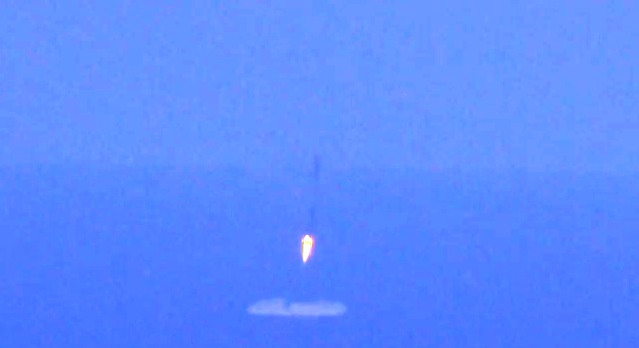 Enhanced frame from a video released by SpaceX on August 14 showing the first stage of a Falcon 9 launched in mid-July just before touching the ocean surface, the most recent test by SpaceX to make the first stage of the Falcon 9 reusable. (credit: SpaceX) SpaceX released late Thursday a new video of the “landing” attempt of the Falcon 9 first stage after last month’s ORBCOMM launch. The video, taken from a chase plane, shows the first stage descending as it goes through “supersonic transition,” according to the video, then cuts to the relight of the first stage engines just above the ocean surface. Unfortunately, the stage slips from view just as the stage touches down on the ocean. “Plane camera with extra long lens loses sight of rocket just before splashdown,” the video explains.
While the video was posted to YouTube on Thursday, it’s not the first time the video has been shown in public. In his keynote address at the AIAA/USU Conference on Small Satellites on August 4 at Utah State University in Logan, Utah, Steve Jurvetson of venture capital firm Draper Fisher Jurvetson—an investor in SpaceX—showed the same footage. “This has never been seen outside of SpaceX,” he told an audience of more than 1,000 before showing the video. “They said they’re going to do better tracking next time,” he said of SpaceX as the first stage slipped from view as it touched down. “They’re going to nail it.”
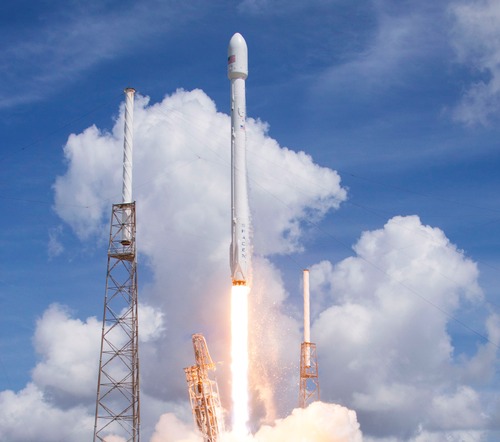 A Falcon 9 v1.1 lifts off from Cape Canaveral, Florida, on July 14. Some of the workers involved in that and other SpaceX activities are suing the company over alleged violations of state labor laws. (credit: SpaceX) While SpaceX has gotten plenty of media attention for its lawsuit against the US Air Force regarding the “block buy” contract for Evolved Expendable Launch Vehicle (EELV) missions with United Launch Alliance, the company is also on the receiving end of lawsuits. Last week, the company was named as the defendant in two separate suits from former employees, alleging the company has violated different aspects of state and federal labor laws.
On August 4, two former employees filed suit, claiming they and up to 400 others were laid off from SpaceX’s Hawthorne, California, headquarters without proper notification. In the suit, plaintiffs Bobby R. Lee and Bron Gatling said they were terminated as part of a “mass layoff” by SpaceX on or around July 21. They and others—the suit estimates that between 200 and 400 employees were laid off—were not given advance notice, as required under state and federal law.
Under California’s Worker Adjustment and Retraining Notification (WARN) Act, a stricter version of similar federal law, employers must give 60 days’ advance notice of any “plant closing, layoff or relocation of 50 or more employees within a 30-day period,” regardless of the overall number of employees. SpaceX did not file a WARN notice with the state.
The case may come down to whether the affected employees were indeed “laid off” or “fired,” that is, terminated for cause. The federal WARN status makes clear that termination for cause is not included in employment losses that require a notification and advance notice, although California law is more vague, defining a layoff as “a separation from a position for lack of funds or lack of work.”
SpaceX has made it clear that it considers the separated employees fired, not laid off. The company said the “headcount reduction” came after an annual review, with the company firing low-performing employees. “We did our annual performance review, there were some low performers, and we terminated them,” said company president Gwynne Shotwell in a brief interview at the NewSpace 2014 conference in San Jose last month. SpaceX also said the reduction was “less than 5%” of the company’s overall workforce, which would put the total number of terminated employees at no more than 200, not the 200-400 that the suit claims.
A second suit by a former SpaceX employee claims that the company is violating labor laws by not giving workers breaks as required by California law. In the suit filed with the LA Superior Court on August 8, former employee Joseph A. Smith alleges that the company’s hourly employees “were consistently required to work in excess of four hours without be provided proper ten minute rest periods” as required by state law, according to a copy of the suit obtained by this publication. The company also denied a 30-minute meal period for shifts longer than five hours, and a second such period for shifts in excess of ten hours. SpaceX also required hourly employees to “work ‘off the clock’ and without pay by rounding time entries.”
As with the termination lawsuit, this suit seeks class action status to cover all affected employees. The suit doesn’t provide a firm estimate of how many that would include beyond that it’s in excess of 100 people. The suit seeks a variety of compensation for pay due to those in the affected class, including interest on back pay and attorneys’ fees. However, the suit notes that the “aggregate potential damages and recovery” sought is believed to be less than $5 million.
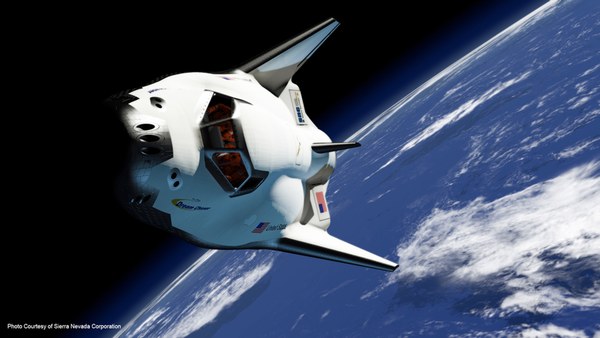 Illustration of the Dream Chaser spacecraft in orbit. (credit: SNC) [Editor’s Note: The following report from last week’s AIAA Space 2014 conference in San Diego is by Duane Hyland.]
Sierra Nevada Corporation’s (SNC) Dream Chaser spacecraft is “on track for its anticipated first launch in November 2016,” Mark Sirangelo, corporate vice president of SNC Space Systems, told a press conference on August 5 at the AIAA SPACE 2014 Forum in San Diego.
Sirangelo explained “that the first launch, out of Florida’s Space Coast, would be one of two required for certification of the spacecraft, and will be unmanned.” The second launch, scheduled for November 2017, would be manned and piloted.” Sirangelo told the audience that “the tests are on track, and that the launch slots have been obtained.” He noted that SNC would fly “five test flights of Dream Chaser, with three of them being manned, in order to by fully comfortable with the craft’s ability to carry humans into space.”
Sirangelo also reaffirmed that the vehicle would use the Atlas V rocket to launch, confirming that SNC was staying with the vehicle despite ongoing concerns about ability to obtain the rocket’s RD-180 engines from Russia in light of current geopolitical concerns. Sirangelo explained that they selected the Atlas V because of its heritage. “We don’t want to worry about the design and structure: it will be over 50 flights and close to 60, by the time we put humans on board,” he said.
Sirangelo also noted that SNC “owns the Atlas Vs that will be used for launch,” so that would be another reason not to worry about the possible disruption to the RD-180 supply. However, he noted that Dream Chase “is agnostic, it can fly on any system, so we are not wedded to the Atlas V,” suggesting some flexibility should the anticipated supply shortage become a reality.
When asked if the Atlas V would need extensive retrofitting to carry the vehicle, Sirangelo said, “It’s a whole lot less complicated than you would think,” specifying that that “the vehicle interface, which will link the craft to the Atlas V rocket, is being built now.” He added that after the interface, the next needed item for launch is “an emergency detection system, required to let the crew know if there is a problem that requires the flight to be aborted.” Once both the interface and emergency detection system are in place, Dream Chaser will be ready to fly on the Atlas V.
Sirangelo also expressed confidence in the craft’s unique lifting body, saying that there is a multitude of capsule-based vehicles right now, ranging from the existing vehicles that support the ISS to NASA’s Orion spacecraft. “In that complex world, we think that having a lifting body has a real practical purpose.”
Asked if there was a risk of Dream Chaser’s exclusion from the next phase of NASA’s commercial crew program, Sirangelo said he was not worried. “Now is a great time for rumors, but I think from what we see it will be multiple companies and vehicles,” he said. “Practically speaking it would be difficult to make that downselect now: we are the only one starting to fly real hardware, but we are a long way away from a real final decision on the program.”
Sirangelo closed the press conference by discussing Dream Chaser’s unique abort system. “It’s one of the things we really spent a lot of time on, and is one of strongest parts of the design,” he said. Triggered at any time during the launch sequence, Sirangelo said the system allows the vehicle to “fly off the stack, abort, and land at a facility a few miles away, or on any standard runway capable of handling a Boeing 737.” The system also acts as ancillary propulsion on orbit, allowing greater maneuverability, and the ability to perform missions like satellite repair with greater precision. If the motors are not used, their non-toxic fuel is simply vented out before the craft’s return to Earth.
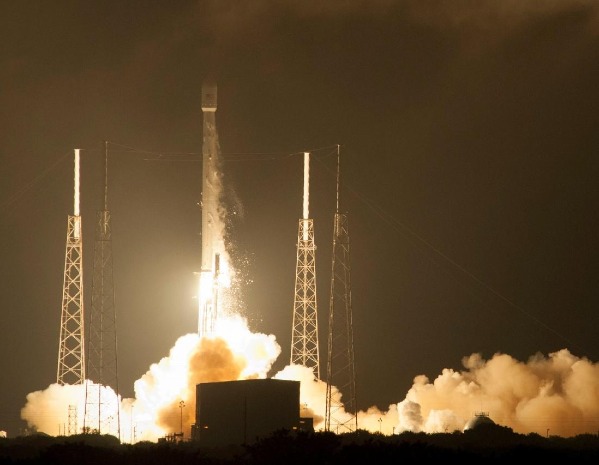 A Falcon 9 v1.1 rocket lifts off from Cape Canaveral, Florida, on August 5, carrying the AsiaSat 8 satellite. (credit: SpaceX) Early Tuesday morning, SpaceX performed the latest launch of its Falcon 9 v1.1 rocket, placing the AsiaSat 8 satellite into orbit. While the launch was originally scheduled for 1:25 am EDT (0525 GMT), a problem with the vehicle’s first stage—never explained in detail by SpaceX—pushed the launch back towards the end of an unusually long launch window. The problem was resolved, though, and the Falcon 9 lifted off at 4:00 am EDT (0800 GMT), releasing the AsiaSat 8 satellite into geostationary transfer orbit.
While SpaceX didn’t issue a press release about the launch, AsiaSat did, confirming the launch was successful and that the Space Systems Loral-built satellite was operating normally. The launch is the first of two back-to-back missions for AsiaSat: a second Falcon 9 will launch AsiaSat 6 towards the end of the month. (This launch demonstrated a three-week turnaround between launches, so assuming that can be maintained, another launch at the end of the month is feasible.)
Unlike the previous two launches, SpaceX did not attempt to “land” the first stage in the ocean, citing the need to reserve the rocket’s performance for the payload. SpaceX CEO Elon Musk did tweet that they did relight the first stage’s engines after stage separation, though:
That launch took place less than a day after SpaceX confirmed it eventually shift commercial launches like this one from Texas. Gov. Rick Perry announced that SpaceX has agreed to build its planned commercial launch complex on the coast of the Gulf of Mexico east of Brownsville. That announcement was expected after the FAA completed an environmental review of the proposed spaceport and gave its OK last month for the project to proceed.
Texas is providing a relatively modest amount of funding for the project: it will provide $2.3 million from the Texas Enteprise Fund, plus $13 million from a separate Spaceport Trust Fund to Cameron County to support infrastructure work needed for the spaceport. The release from Perry’s office cites “$85 million in capital investment into the local economy” from the spaceport, suggesting that SpaceX will provide the bulk of that funding for the project.
And there was a smaller development for SpaceX as well this week: a new landlord. Chambers Street Properties announced it was buying the building that serves as SpaceX’s headquarters in Hawthorne, California, for $46.7 million. SpaceX leases the building under an agreement that runs through January 2023, and there’s no indication that the sale would affect the company in any significant way.
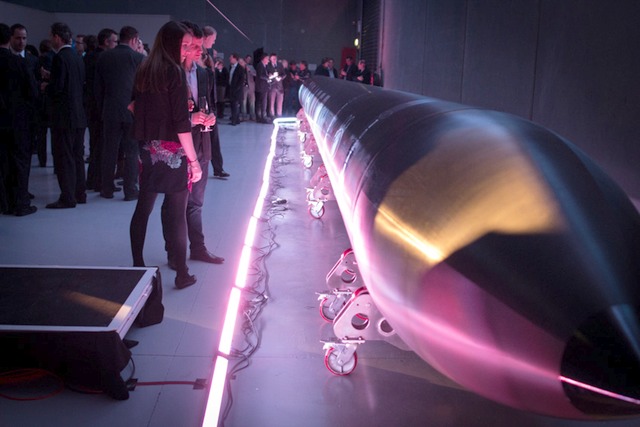 Attendees of a July 29 event unveiling the Electron rocket look at a model of it on display. (credit: Rocket Lab Ltd.) It seems like hardly a week goes by this summer without another smallsat launch venture announcing their plans. That’s an exaggeration, but only a mild one. In early July, Firefly Space Systems announced Firefly Alpha, a vehicle designed to place up to 400 kilograms into low Earth orbit (LEO) for $8–9 million. At the NewSpace 2014 conference last week, CubeCab, a company that plans to develop an air-launch system for individual CubeSats, won the $20,000 first prize in the Lightning Pitch competition.
Now a company based in both New Zealand and the United Stated is joining the fray. Rocket Lab Ltd. announced plans Tuesday for Electron, a smallsat launcher designed to place 110 kilograms into a 500-kilometer Sun-synchronous orbit for $4.9 million.
“The innovation behind Electron will release the limitations on launching small satellites,” said Peter Beck, CEO of Rocket Lab Ltd., in the announcement about the company. “Our vision at Rocket Lab is to make space commercially viable and more accessible than ever, doing what the Ford Model T did for consumer automobiles.”
Rocket Lab appears to be taking a page from SpaceX in its vehicle design. Electron uses a design like the Falcon 9, using nine “Rutherford” engines in its first stage and a single engine of the same design (with what appears to be a different nozzle to work better in vacuum) in the second stage. (Electron also has a solid-propellant third stage.) Rocket Lab’s Rutherford engine uses liquid oxygen and kerosene, producing about 13,300 newtons (3,000 pounds-force) of thrust.
However, the company’s announcement generates many questions as well. The company has an unusual structure, calling itself “an American company with a subsidiary and head office in Auckland, New Zealand.” While the announcement is datelined in Los Angeles, the unveiling event took place in New Zealand, heavily covered by the local press. The company doesn’t explain this arrangement, which may have some contractual benefits (such as being able to compete for US government business) but likely also has export control and other challenges as well.
Rocket Lab says its principal funder is Khosla Ventures, a Silicon Valley venture capital (VC) firm run by billionaire Vinod Khosla, a co-founder of Sun Microsystems. The size of the investment, announced last October, isn’t disclosed. Rocket Lab does not appear on the portfolio page of Khosla Venvtures’ website, and the fund did not respond to a email inquiry earlier this week regarding its investment in Rocket Lab. Khosla himself, though, is quoted in the release, saying that Rocket Labs’s “technical innovations will truly transform the space industry.”
Khosla, though, is not the only source of funding for the company. The company announced earlier this year it won a Callaghan Innovation Research and Development Growth Grant form the New Zealand government. The size of that grant isn’t disclosed, although one local media report indicated it was valued at NZ$25 million (US$21.3 million). That report also said the company has received investment from another individual, Sir Stephen Tindall.
Those media reports also indicated that Rocket Lab plans to launch the first Electron later this year from a private launch facility somewhere in New Zealand. Rocket Lab has “commitments for its first 30 launches,” according to the announcement, but did not disclose those customers, and whether those “commitments” are signed contracts or less binding letters of intent. (Rocket Lab did not respond to questions on these and other issues submitted via email on Tuesday morning.)
Ultimately, Rocket Lab and other ventures in this market may face the same challenge, regardless of their different technical approaches: is there sufficient demand from the smallsat industry for dedicated launches at these prices? SpaceX withdrew the Falcon 1 from the market because of, according to it, a lack of demand, even though that vehicle had similar capabilities and prices as some of these new ones. Certainly interest in smallsats has grown considerably in recent years, but that demand is also being fulfilled, for the moment, primarily by less expensive secondary launch opportunities.
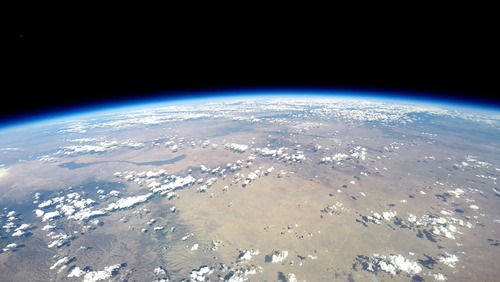 A view of the Earth taken from an altitude of 36 kilometers (120,000 feet) on a World View test flight June 18. The company plans to use that balloon to fly research payloads later this year. (credit: World View) World View Enterprises, the company developing a commercial high-altitude balloon system to provide a flight experience like some aspects of spaceflight, has selected an initial group of research payloads that will fly on one of the company’s balloons as soon as this year, as the firm diversifies beyond tourism.
The three experiments, announced in a company press release July 28, are a radiation measurement experiment by Space Environment Technologies, a meteor imager from the SETI Institute, and a student-built ozone monitor from the Florida Space Grant Consortium. The three are slated to fly in late 2014, according to the company.
“In the research and education world, we think we offer something really special,” said Alan Stern, a founder of World View and the company’s chief scientist, in a speech at the NewSpace 2014 conference in San Jose, California, on July 26. Experiments can be automated or, in later crewed versions of World View’s balloon, human-tended. “We can let researchers operate the same way that they do in a university of industrial lab, removing the need for automation.”
These three experiments will fly on the Tycho-800 balloon, which the company flew on its first test flight in mid-June. At that time, World View chief technology officer Taber MacCallum said the company had gotten early interest in using that balloon for technology demonstration and other research. “It looks like that, early on, we could be in the business of doing experiments and test flights,†he said at the time.
Stern said in his NewSpace speech that the company has also seen interest in using the balloons as commercial platforms beyond research and tourism. “In addition, there’s a very large interest that we’re seeing in something called ‘stratollites,'” which he defined as high-altitude balloons performing missions traditionally done by satellites, but at much lower costs. These applications could include both remote sensing and communications; in the latter case, companies like Facebook and Google have expressed interest in stratospheric platforms (balloons and UAVs) as a means of providing Internet access.
“The interesting thing from our perspective, starting this off as a company with an interest only in research and education and tourist markets, how often we find other businesses and government agencies knocking on our door” to see how they could use a balloon platform like World View, Stern said. “We think of the stratosphere as a greenfield, ready for development with the technology of the 21st century.”
World View, though, is still planning to fly tourists, with those flights slated to begin in late 2016. “It’s going to be a tremendous experience,” Stern said of those flights, which will carry six people and two crew into the stratosphere with amenities not found in spacecraft. “This is the only spaceship that I know of that’s got a bar.”
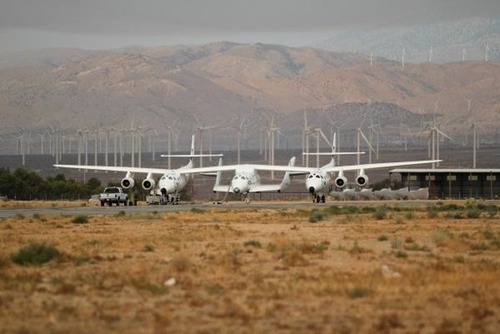 SpaceShipTwo, attached to its WhiteKnightTwo carrier airplane, taxies before takeoff on its latest test flight July 29. (credit: Virgin Galactic) For the first time in more than six months, Virgin Galactic’s SpaceShipTwo flew on Tuesday, albeit not under rocket power. The vehicle made its 29th glide flight, with pilots Michael Masucci and Pete Siebold at the controls. Virgin didn’t disclose the purpose of the flight beyond being part of the company’s overal test program. “As the world’s first commercial spaceline, we’re committed to conducting a thorough test flight program” for SS2 and its carrier aircraft, WhiteKnightTwo, the company said in a tweet.
The flight was the first time SS2 flew since a glide flight on January 17, according to the flight test logs maintained by Scaled Composites. SS2 has made three powered test flights, most recently on January 10. Since then, the company has changed the fuel used in the hybrid rocket motor in SS2, switching from a rubber-based fuel to a nylon one.
There have also been a couple personnel additions at Virgin Galactic and The Spaceship Company (TSC), the Virgin-owned venture that builds the vehicles. On July 24, Virgin announced it had hired a new pilot, Todd “Leif” Ericson, a former US Air Force test pilot. And on Wednesday, Virgin announced that former Scaled president Doug Shane is now the president of TSC. Shane joined TSC last year as executive vice president and general manager; the reason for the position change wasn’t indicated.
The release offered one other item about Virgin’s efforts: work on the second SS2 vehicle is now “roughly 50%” complete.
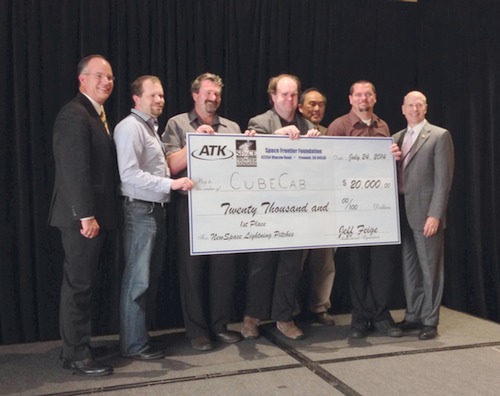 Members of the CubeCab team, including CEO Adrian Tymes (center), and prize sponsors pose with the $20,000 first-prize check at the Lightning Pitch awards ceremony Thursday evening. (credit: J. Foust) For the second year in a row, a company that seeks to develop an air-launch system for small satellites has won a business plan competition organized by the Space Frontier Foundation.
CubeCab beat out six other companies in the competition held Thursday during the NewSpace 2014 conference in San Jose, California. The “Lightning Pitch” competition was a slimmed-down version of previous business plan competitions held by the organization, with companies required to give a four-minute pitch to judges, followed by a three-minute question-and-answer session.
CubeCab won the $20,000 first prize by pitching an air launch system that can place individual CubeSats into orbit. The system would be able to place individual CubeSats into orbit on dedicated launches at the same price as current rideshare arrangements, where CubeSats fly as secondary payloads on larger launch vehicles: $100,000 for a 1U cubeSat and $250,000 for a 3U CubeSat.
“The judges felt they were in line to solve one of the number one problems that we have in our industry,” said Thomas Olson, organizer of the competition, during a brief awards ceremony Thursday evening, alluding to the challenges CubeSat developers face in getting their spacecraft launched. “They had a management and technical team they thought was really unsurpassed among all the contestants today.”
CubeCab disclosed few specifics about their air-launch design. In his brief pitch, company CEO Adrian Tymes listed some technologies the system will incorporate, from room temperature self-pressurizing propellants to the use of 3-D printed components, but not a complete system architecture. “We’re still weighing the various options,” he said in a brief interview after winning the competition Thursday evening.
CubeCab believes it can develop this system quite inexpensively. Tymes said in his presentation that the company is seeking $500,000 in a seed round and $4–5 million in a Series A round. That would be sufficient, he said, to develop the system, although he said the company might need a couple million dollars more to give it “runway” before revenue from launch services kicked in. The presentation, though, didn’t given the company time to break down its costs.
Tymes, in the interview Thursday evening, said he planned to set aside half of the $20,000 prize to cover future expenses, and the rest to pay off some debts and provide bonuses to the team. “We have major credibility as this point,” he said exuberantly in the interview. “This is a victory for the democratization of space.”
CubeCab is the second air launch company in as many years to win first prize at a business competition run by the Foundation. Last year, when the organization ran a full-fledged business plan competition, Generation Orbit won first place.
In this year’s competition, RockZip, a maker of high-altitude balloons, won second place at $7,500. Elysium Space, a company that plans to launch cremains into space inside CubeSats, won the $2,500 third prize.
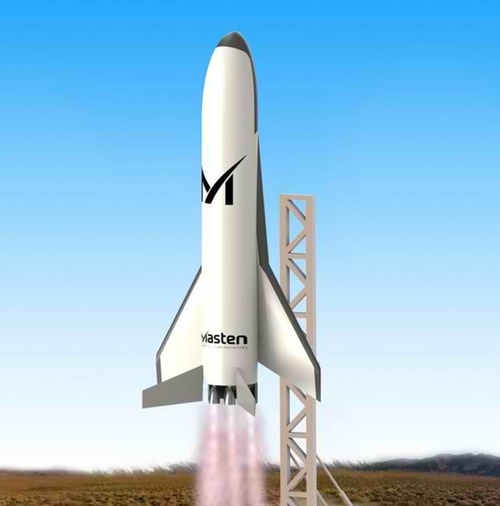 An illustration by Masten Space Systems of its Xephyr design that was funded by DARPA for Phase 1 of the XS-1 program. (credit: Masten Space Systems) Masten Space Systems, one of three companies to receive awards from DARPA for the Experimental Spaceplane 1 (XS-1) program, has revealed the design it proposes to develop for the program. And that design has something unusual for a company best known for its vertical-takeoff-and-landing designs: wings.
The “Xephyr” vehicle does take off vertically, as shown in the illustration provided by the company. However, the design also has small wings, presumably to allow it to glide, either for landing or other phases of flight. Overall, the design bears similarities to the X-34, an experimental spaceplane developed by Orbital Sciences for NASA but cancelled before its first flight. The X-34 featured a single tail while Mastern’s Xephyr features two. The X-34 was also designed to be air-launched from an aircraft, while Xephyr will launch vertically and would eventually become an air-launch platform itself for an expendable upper stage. (It’s worth noting that XCOR Aerospace, which has experience with winged vehicles, is partnered with Masten on its XS-1 contract.)
“XS-1 comes at the right time for the industry and the right time for Masten,†said Masten CEO Sean Mahoney in a company press release issued Wednesday. “The tide is turning and space access is opening up. We’re thrilled to lead a team to tackle the hard problems DARPA has put in front of us.â€
Masten is one of three companies awarded Phase 1 contracts by DARPA for the XS-1 program. The other two are Boeing and Northrop Grumman.
|
|

Recent Comments