Skyline of Richmond, Virginia

The happiest launch failure ever?

03.22.07

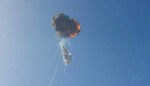
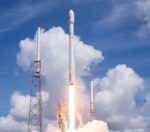
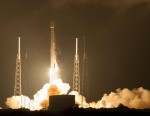
A lot has already been said about the Falcon 1 launch earlier this week, so rather than recap and reanalyze the launch from a technical standpoint, I’ll make this observation. It was initially a little surprising to hear that SpaceX people were celebrating, having champagne toasts, and, in general, calling the flight mostly a success. After all, their rocket had failed to reach orbit, the one factor that counts in a launch. In the most binary sense, this was a failed launch: being 90-95% successful is no consolation to the customer whose satellite failed to make orbit.

Of course, though, this wasn’t a satellite launch but rather a test flight, where that 90-95% success is actually meaningful, something I (and others) explained in a news@nature.com article published today. It’s still a little odd to hear people celebrating a success even as the second stage lost roll control, but in any case the launch is a significant step forward in SpaceX’s long-term efforts to develop launch vehicles and spacecraft capable of eventually carrying people into orbit.

Elon Musk, Virgin Galactic customer

01.05.07

On Wednesday night PBS aired a pilot of a new science show, Wired Science. (If you missed the show you can watch it online; the show is competing against two others to win a slot in the network’s lineup). One segment of the show featured an interview of Elon Musk, where host Brian Unger first asked him questions about his electric car startup he’s funding, Telsa Motors. Unger then turned to SpaceX and brought up a number of other commercial space ventures, like Blue Origin and Virgin Galactic. That led to this interesting exchange:

Unger: Who is your competition?

Musk: [long pause] We have no serious competition.

Unger: None?

Musk: Not presently.

Unger: So that Branson guy’s kind of a hack, then?

Musk: Well, what Branson’s doing—by the way, I’m a great admirer of Branson—is really a much smaller technological challenge. So their craft would be suborbital, so it would go to about Mach 3. Our craft is orbital, it goes to Mach 25, so 25 times the speed of sound. To do what Branson’s doing you need, say, about nine units of energy. To do what we’re doing you need 625 units of energy. The difference is monumental. So what Branson is doing from a technological standpoint is building something that can cross the English Channel. What we’re building is something that can circumnavigate the globe. I still think what he’s doing is great, and, by the way, I bought a ticket on his effort. But it’s not in the same league, technologically.

Unger: So you’re not particularly worried?

Musk: The things that worry me are, are we going to make a mistake? Our own foolishness, our own errors, can hurt us.

Unger: So rocket science really is rocket science?

Musk: Yeah. [laughs] It looks hard, and it’s harder than it looks.

SpaceX, RpK win COTS awards

08.18.06

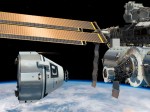
NASA announced this afternoon that, as many people suspected in the days leading up to this afternoon’s announcement, that SpaceX and Rocketplane Kistler (RpK) won Commercial Orbital Transportation Services (COTS) awards to develop cargo and crew transportation vehicles to serve the ISS. SpaceX proposed the Dragon capsule, launched atop a Falcon 9, as described in an article I wrote in this week’s issue of The Space Review.

SpaceX said in a press release that they planned to perform three test flights of the Dragon in late 2008 and early 2009. RpK proposed the K-1 vehicle that Kistler Aerospace developed (and started to build) in the 1990s, with a module to carry cargo or passengers. RpK plans to perform the first flights of the K-1 in early 2008 and said in a statement that it remains committed to its XP suborbital spaceplane, which will make its first flights in “late 2008″, a bit later than previous plans.

Both vehicles also plan to serve commercial markets, such as orbital space tourism; Musk has previously stated an interest in supporting Bigelow’s orbital modules. Both companies will also be leaning on the private sector for funding to support the development of the vehicles: MSNBC reports that SpaceX is planning to spend around $200 on Dragon and Rocketplane would get on the order of $400 million in private financing.

SpaceX and RpK beat out four other finalists for the COTS award: Andrews Space, SpaceDev, SPACEHAB, and t/Space. Of the four, only SpaceDev has issued a statement since the award announcement, congratulating the winning companies as well as to NASA. “We will continue to look for other avenues to develop these technologies and further our capability to advance commercial space transportation,” said company CEO Mark Sirangelo.

Now the hard part—but also the fun part—begins: turning these winning designs into real spacecraft.

Mars on the cheap?

05.19.06

PC Magazine, of all publications, has a summary article of the appearance by Space Adventures’ Chris Faranetta and SpaceX’s Elon Musk at the Future in Review (or FiRE) conference in San Diego. (See earlier post.) There’s not too much new here: both go over their plans, and discuss some far-future propulsion breakthroughs (Faranetta is fond of laser propulsion, while Musk is not; both are disdainful of the space elevator concept.) Musk, though, has his eye firmly set on low-cost passenger travel to Mars, and soon:

“I hope that we’re the primary mechanism for getting people to orbit in the world,” said Musk. “By 2020 I’d like to take someone to another planet.” He believes that within 12 years or so, the cost of taking someone to Mars will be little more than “the price of a median house in California,” or just a few million dollars each.

Of course, by 2020 a few million dollars may not buy you anything in the most overheated regions of California’s real estate market.

Space Adventures and SpaceX review the future

05.17.06

SpaceX founder Elon Musk and Space Adventures vice president Chris Faranetta discussed space tourism and the future of commercial space ventures during talks Tuesday at the “Future in Review” conference in San Diego, CNET News.com reports. There’s not much news in this report, other than a comment by Faranetta that Space Adventures hopes to sign up two passengers for its proposed circumlunar flight by 2008.

COTS and space tourism

05.11.06

By now you’ve probably heard that NASA has shortlisted a half-dozen companies (that we know about, at least) for further consideration in its Commercial Orbital Transportation System (COTS) program for ISS resupply. According to MSNBC and other sources, the six companies that got the nod from NASA are Andrews Space, Rocketplane Kistler, SpaceDev, SPACEHAB, SpaceX, and t/Space. (SPACEHAB is the only one of the six to formally confirm the selection in a press release as of early this morning.) Final selections are expected some time this summer.

What does this mean for commercial space tourism? A majority of the companies listed above have suggested, if not openly stated, that they plan to develop passenger vehicles to serve markets beyond ferrying crews to and from ISS. Both Rocketplane and SpaceX have stated that they plan to develop their manned vehicles regardless of COTS; getting a COTS contract would simply accelerate the process. T/Space has talked about the market for space tourists using its CXV vehicle in past conference presentations, while SpaceDev is also looking beyond just ferrying astronauts. What’s less clear is what orbital tourism plans, if any, Andrews and SPACEHAB have: SPACEHAB makes no mention of passenger services in its press release while Andrews remains tight-lipped about its plans.

Musk on SpaceX’s capsule project

05.05.06

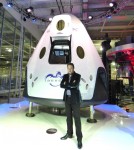
During the Q&A session after his speech Thursday morning at the ISDC, Elon Musk of SpaceX divulged some details about the development of a manned capsule the company has been quietly working on. “It’s been a low priority because obviously we have to get the booster right before,” and his voice trailed off to some laughter from the crowd. “We’re putting the cart before the horse.” He revealed that work on the capsule has actually been on hold for some time. “We stopped work on our prototype manned capsule a little over a year ago because it was way ahead of the booster.” Winning a NASA COTS contract, he said, would accelerate the development of the capsule: with that funding he believes the capsule would be ready to fly in 2009. “If we don’t, then it probably gets delayed by a couple of years” to around 2011, he said. He added that without the COTS funding SpaceX would develop a “scaled down version” of the capsule “with a little less capability.”